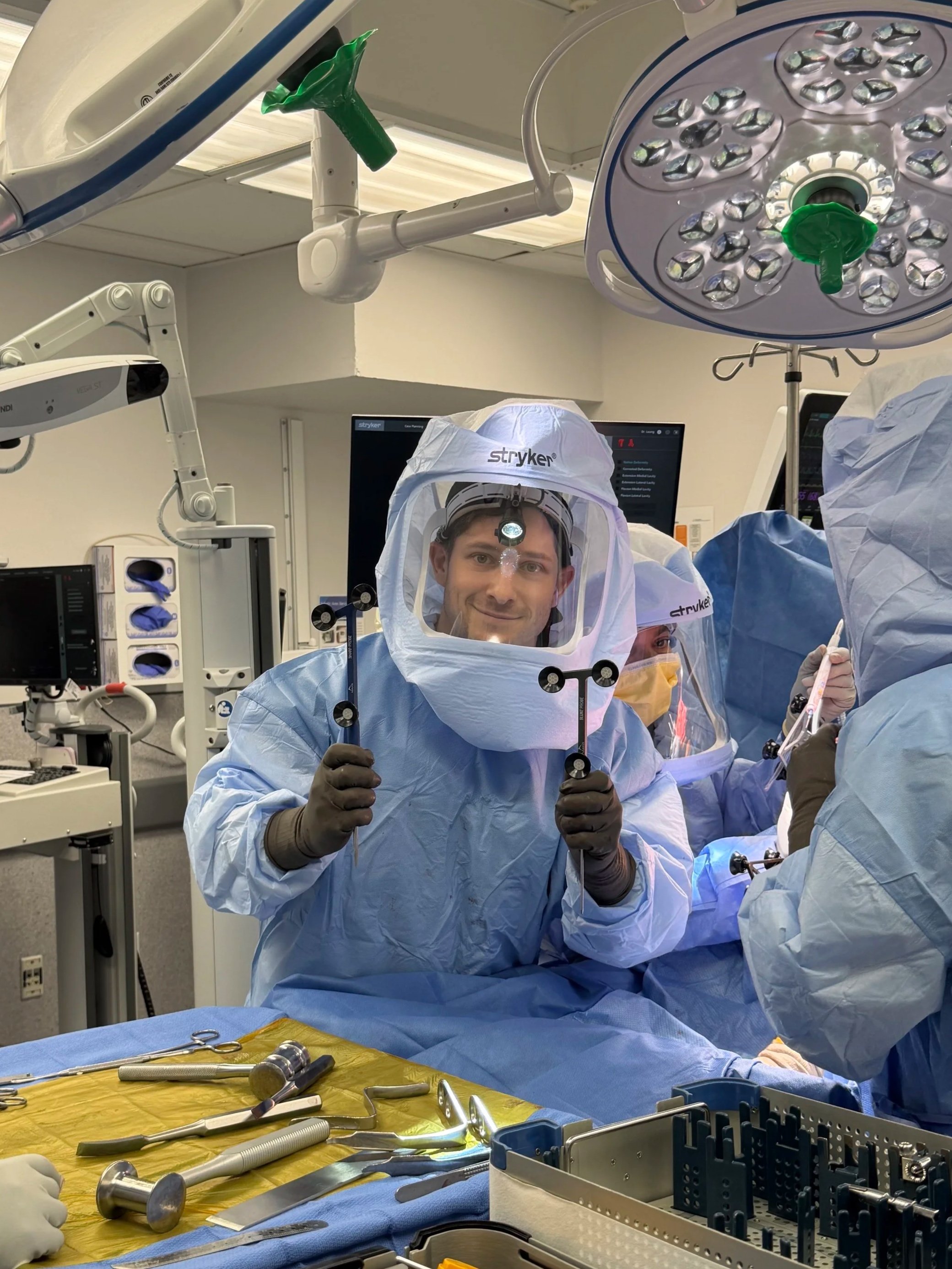
Dr. Maximillian P. Ganz — Robotic-Assisted Joint Replacement Surgery
Deciding to move forward with a joint replacement is a major step toward reclaiming your active lifestyle. If you or a loved one are researching hip or knee replacement options, you have likely come across the term robotic-assisted surgery.
While the word "robot" can sound futuristic or intimidating, the reality is a powerful tool for patient safety and precision. In modern orthopedic surgery, the robot doesn't replace the surgeon—instead, it acts as an advanced guidance system that gives your surgeon unprecedented control.
Here is a breakdown of why robotic-assisted technology provides a superior option for patients, and what it means for your recovery.
1. Unmatched Precision and Alignment
Every patient's skeletal anatomy is entirely unique. Traditional joint replacement relies on standard mechanical guides and visual alignment during the procedure.
Robotic-assisted technology uses a 3D virtual model of your specific joint, mapped out prior to or during the procedure. This allows your surgeon to plan the exact size, placement, and alignment of your implant down to the millimeter. Better alignment means the new joint mimics your natural biomechanics more closely, which directly translates to a more natural-feeling joint and a longer-lasting implant.
2. True Tissue-Sparing Techniques
One of the greatest fears patients have regarding joint surgery is trauma to the surrounding muscles and soft tissues.
Because the robotic system provides real-time, high-definition visual boundaries, your surgeon can execute extremely precise bone cuts while actively protecting critical ligaments, tendons, and muscles. Less disruption to the surrounding tissue means:
Less post-operative pain
Reduced swelling and bruising
A significantly lower reliance on narcotic pain medications after surgery
3. A Customized Plan Tailored to You
No two knees or hips are worn down in the exact same way. Robotic technology allows your surgeon to adjust your surgical plan dynamically in the operating room based on real-time tension and soft-tissue balance. This customization ensures that your new joint is balanced specifically for how you move.
What This Means for Your Recovery
When you combine advanced robotic-assisted technology with modern, muscle-sparing approaches (such as a direct anterior total hip replacement), the recovery timeline changes dramatically. Many patients experience a faster return to independent walking, shorter hospital stays, and a quicker transition back to the activities they love—whether that's golf, traveling, or keeping up with family.
Caring for Long Island, Close to Home
Achieving an exceptional surgical outcome goes hand in hand with choosing a team that prioritizes both technical precision and comprehensive pre-operative optimization.
If you are exploring your options for joint replacement in Nassau or Suffolk County, I invite you to schedule a consultation. Together, we can discuss whether a robotic-assisted approach is the right path to get you back on your feet.
Dr. Maximillian P. Ganz is a fellowship-trained orthopedic surgeon specializing in adult reconstruction and joint replacement with Orlin & Cohen, an affiliate of Northwell Health, serving patients across Long Island with primary surgical privileges at Syosset Hospital and Huntington Hospital.
